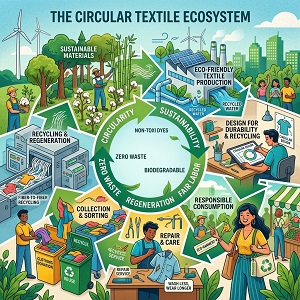

The United Arab Emirates (UAE) has taken a decisive step toward transforming its national textile industry by launching "Naseej," the nation's first integrated initiative dedicated to textile circularity. Announced during "The Fabric of Possibility" event at Yas Mall in Abu Dhabi, this program aims to address the country's textile waste challenge, which generates an estimated 220,000 tons of discarded textiles annually. The initiative, directed by Sheik Mohamed bin Zayed Al Nahyan, seeks to treat textile waste not merely as an environmental concern, but as a strategic opportunity to foster long-term behavioral changes and sustainable practices.
A significant stride toward an environmentally friendly industrial future was recently marked at the Germany-Vietnam Business Forum 2026, held in Ho Chi Minh City. The event, themed 'Circular Economy in Manufacturing,' served as a testament to Germany’s profound commitment to supporting Vietnam's green transition. Through synergies involving technology transfer, knowledge sharing, and long-term business partnerships, both nations now stand at the threshold of a major transformation in the global manufacturing landscape.
Global fashion and consumer goods supply chains are entering a critical regulatory transition as Extended Producer Responsibility (EPR) frameworks for textiles move from policy design to enforceable market requirements. According to the 'Mapping of Global Extended Producer Responsibility (EPR) for Textiles' report by the Global Fashion Agenda, governments across Europe, the Americas, and Asia are rapidly converting voluntary sustainability commitments into binding statutory obligations. This shift treats textile waste not as a municipal burden, but as a producer-level financial liability directly affecting operating margins.
Page 5 of 11