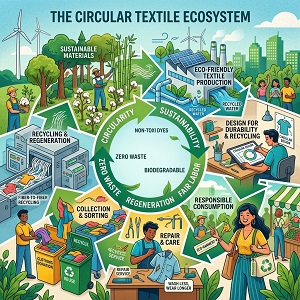

The global fashion industry stands at a critical crossroads. As mountains of textile waste continue to grow, the concept of textile-to-textile recycling has emerged as the "Holy Grail" of circularity. However, transforming an old T-shirt back into a new T-shirt on a global scale requires more than just innovative machinery; it demands a radical systemic overhaul and unprecedented collaboration between rival brands.
At the recent Textiles Recycling Expo in Charlotte, N.C., industry leaders from Target, Unifi, Reju, and Elevate Textiles gathered to dissect the barriers holding this revolution back. Sarah Coulter, Americas program director for Accelerating Circularity, pointed out a sobering reality: of the 90 million tons of textiles generated annually, only one percent is currently recycled. "We know it’s not just a technology problem—it’s a system problem," Coulter stated, emphasizing that the infrastructure to collect and process these materials is lagging behind the science.
For major retailers, the most significant hurdle remains the bottom line. Janelle Hibbard, director of owned brand circular capabilities at Target, noted that recycled post-consumer textiles currently carry a much higher production price tag than virgin fibers. "For us, the biggest limiter is cost," Hibbard explained. She stressed that until costs come down and mills can run recycled feedstock with the same efficiency as standard materials, scaling will remain a challenge.
This price disparity requires a fundamental shift in mindset for both brands and consumers. Diane Woods, global head of business development at Reju, argued that comparing recycled post-consumer waste to virgin polyester is like comparing "apples and oranges." Unlike the highly subsidized and established virgin plastic industry, textile-to-textile recycling is building a new system from scratch. "It’s not likely to ever be equal to virgin [in price]," Woods remarked, suggesting that the value of closing the loop must be weighed differently.
Despite these economic pressures, there is momentum. Jimmy Summers of Elevate Textiles noted that advancements in mechanical and chemical sorting are happening faster than ever. Furthermore, innovative partnerships are beginning to bridge the gap in supply chains. For instance, Reju’s collaboration with Waste Management and Goodwill creates a streamlined flow where non-resalable garments are diverted directly to recycling facilities rather than landfills.
Meredith Boyd, executive vice president at Unifi—the company behind the Repreve fiber used by giants like Nike and Levi’s—urged brands not to wait for a "perfect" solution. She reminded the industry that even now-standard recycled plastics once faced skepticism. "Textile-to-textile is right now at the cusp of an innovation moment," Boyd said.
The consensus among experts is clear: the transition to a circular economy will be messy, involving shared risks and occasional pilot failures. However, the path forward requires brands to stop "sitting on their hands" and start integrating existing scalable solutions into their products today to fuel the innovations of tomorrow.