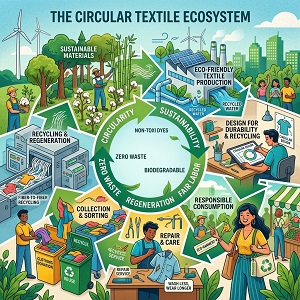

Clothing waste is a rapidly growing global issue, and Australia stands out as one of the highest garment-consuming nations, with a fashion carbon footprint that ranks as the largest among G20 countries. To combat this mounting crisis, researchers at the Royal Melbourne Institute of Technology (RMIT) have developed a sustainable method to transform cotton textile waste into nutrient-rich compost.
According to Amanpreet Singh from RMIT’s School of Fashion and Textiles, Australia’s consumption translates to approximately 47 kilograms of clothing per person annually, with around 24 kilograms of that total being discarded, resulting in millions of tonnes of garments ending up in landfills. Because only a small percentage of this waste is recycled or makes its way into the secondhand market, researchers emphasize that unwanted natural-fiber garments should ideally undergo biodegradation.
The RMIT research initiative was led by Professor Rajkishore Nayak and funded by the Cotton Research and Development Corporation (CRDC)—a strategic partnership between the Australian government and local cotton growers. To tackle the problem, the university assembled a multidisciplinary team spanning its Melbourne and Vietnam campuses, bringing together expertise in textile materials, biodegradation and composting chemistry, and supply chain logistics modeling. The team centered their efforts on identifying the most effective composting method for cotton waste and determining the most economically viable locations for future composting facilities.
The team established a comprehensive five-stage process: collecting textile waste; sorting, cleaning, and shredding cotton-rich materials; executing composting methods; testing compost quality; and identifying optimal locations for future infrastructure. Through their trials, they determined that vermicomposting—a technique utilizing earthworms to break down organic matter—is the superior method for converting cotton waste into nutrient-dense compost. This process produces a natural fertilizer rich in nitrogen, phosphorus, and potassium, which provides a healthier alternative for soil compared to chemical fertilizers.
In the final phase of the project, the team developed a logistics model to pinpoint the most practical and economical sites for Australian composting facilities. Lead logistics and supply chain management professor Vinh Thai explained that selection criteria incorporated land costs, utility and road access, temperature, humidity, and safe distances from residential, cultural, and protected zones. By combining these criteria with quantitative modeling of transport volumes and distances, the researchers identified Ripley Valley in Queensland as the ideal site for a single national composting facility, alongside additional regional sites for individual states. Building upon these findings, ongoing experiments are currently underway at the Brunswick campus to test composting under both controlled and uncontrolled conditions.