
Global non-profit organization Textile Exchange released two comprehensive reports this week detailing a surge in global fiber production alongside sustainability gains across the textile, clothing, leather, and footwear industries. According to the Materials Market Report, global fiber output climbed to an unprecedented 139 million metric tons, up significantly from 132 million metric tons in the previous year.
This volume equates to approximately 17 grams of fiber per person worldwide—more than double the per-capita output recorded 50 years ago. While this rapid growth highlights strong consumer demand across international markets, it also underscores persistent environmental challenges facing the global fashion supply chain.
Polyester Dominance and the Recycling Gap
Polyester remains the dominant force in global fiber manufacturing, accounting for 59 percent of total market output. Its production volume grew from 77.7 million metric tons to 82.5 million metric tons. Although recycled polyester output saw a slight uptick from 9.4 million to 9.7 million metric tons, industry data reveals that true circularity remains limited.
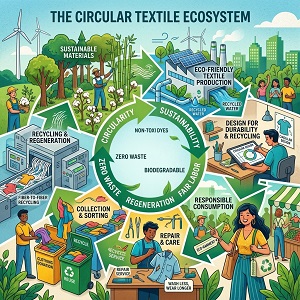
The report emphasizes that 97 percent of recycled polyester fiber is currently derived from plastic bottles rather than post-consumer garments. Across all fiber types, true textile-to-textile recycling accounts for less than 1 percent of total global production, edging up marginally from 0.61 percent to 0.76 percent.
Cotton ranked second behind polyester with an 18 percent market share, followed by manmade cellulosic fibers at 7 percent. Animal fibers, including wool and cashmere, held a combined 1 percent share of global output.
Positive Momentum in Certified Sustainable Sourcing
Despite slow progress in textile-to-textile recycling, sustainable sourcing programs are gaining traction. Cotton produced under certified sustainability programs rose to 9.4 million metric tons, representing 37 percent of all virgin cotton output—a 35 percent increase year-over-year.
Furthermore, two-thirds of manmade cellulosic fibers, such as viscose and modal, were produced using feedstocks certified by the Forest Stewardship Council (FSC) or the Programme for the Endorsement of Forest Certification (PEFC). In the wool sector, the Responsible Wool Standard—which evaluates animal welfare and land management—saw certified greasy wool production rise to 79,135 metric tons, representing 4.5 percent of global supply.
Global Brands Lead the Transition Toward Preferred Materials
Progress was also evident in Textile Exchange’s Materials Benchmark, which aggregated data from 384 participating brands and retailers. Participants increased their overall use of certified and verified sustainable materials from 68 percent to 72 percent. In contrast, preferred fibers represent only 20 percent of total global volume.
Participating companies also reduced their reliance on virgin fossil-fuel-based polyester from 0.54 million metric tons to 0.48 million metric tons, defying global trends where overall virgin polyester output surged from 68 million to 73 million metric tons.
Beth Jensen, Chief Impact Officer at Textile Exchange, noted that the benchmark findings demonstrate what can be achieved when companies commit to collective goals. However, she stressed that industry leaders must continue accelerating efforts to scale regenerative agriculture and true textile-to-textile recycling systems to transform isolated progress into lasting global impact.