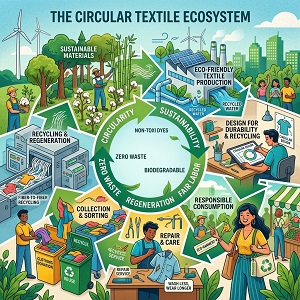

The global textile industry is facing an unprecedented environmental turning point. With clothing production doubling over the last two decades, textile waste is accumulating in global landfills at a rate of one garbage truck every second. Amidst this crisis, a technological solution has emerged that is considered the "holy grail" of sustainability: Chemical Fiber-to-Fiber Recycling. This technology does not just recycle plastic bottles into fabric; it transforms old garment waste back into new fibers with a quality equivalent to virgin materials.
Traditionally, textile recycling has been done mechanically by shredding fabric into short fibers. Unfortunately, this process damages the fiber structure, meaning the output can only be used for low-value products like building insulation or carpet padding (downcycling). Another major challenge is that most modern clothing is made from blended materials—most commonly a combination of polyester and cotton (poly-cotton). Separating these two materials mechanically is nearly impossible without destroying one of them.

This is where chemical recycling acts as a game-changer. The process works at the molecular level. Textile waste is dissolved in a specialized chemical solvent capable of separating polyester polymers from cotton cellulose. The polyester is returned to its original monomer form, while the cotton is reprocessed into regenerated cellulose fibers, such as viscose or lyocell. The end result is a fiber with strength, luster, and dye absorption identical to newly made fibers from petroleum or trees, allowing it to be spun back into high-quality yarn for high-street fashion.
A true pioneer that has implemented this technology on a commercial scale is Renewcell, a Swedish company partnering with retail giant H&M Group. Their product, known as Circulose, is produced by recycling 100% cotton waste into a new cellulose pulp. Representatives from H&M Group have stated that their investment in chemical recycling technology is part of the company's commitment to becoming 100% circular by 2030. They emphasize that without the ability to recycle fiber-to-fiber, the fashion industry can never break its dependence on new natural resources.
Furthermore, the Finnish technology company Infinited Fiber Company has captured global attention with its Infinna technology. Their process can transform cellulose-rich textile waste into premium textile fibers that feel like cotton. Major brands such as Patagonia, Adidas, and Inditex (Zara) have signed cooperation agreements to use these chemically recycled fibers in their collections. This proves that the technology is no longer just a laboratory experiment but an industrial-scale solution ready to reshape global supply chains.
From a research perspective, The Hong Kong Research Institute of Textiles and Apparel (HKRITA), through its "Green Machine" project, has successfully developed a hydrothermal method to separate polyester-cotton blends on a large scale. Edwin Keh, CEO of HKRITA, has explained in various industry forums that the key to a circular economy lies not only in garment design but in a waste processing infrastructure capable of recovering material value. According to him, chemical technology allows us to see textile waste not as trash, but as an "above-ground mine" providing raw materials without the need to destroy forests or drill for oil.
In Indonesia, this spirit is also growing through research institutions such as the Center for Advanced Materials Research (BRIN) and Politeknik STTT Bandung. Researchers at these institutions continue to explore the use of eco-friendly "green solvents" for the chemical recycling process to ensure that chemical residues do not create new environmental problems. they emphasize that implementing this technology in Indonesia is crucial, given Indonesia's position as one of the world's largest textile producers also facing mountains of fabric scrap waste from the garment industry.
However, the full transition toward fiber-to-fiber recycling still faces logistical challenges. Collecting and sorting textile waste by fiber type requires sophisticated automation systems, such as Near-Infrared (NIR) spectroscopy. Additionally, the cost of building chemical recycling facilities requires significant capital investment. Nevertheless, with strict regulations from the European Union regarding Extended Producer Responsibility (EPR)—which mandates that producers take responsibility for their products' waste—the economic incentives for this technology are growing stronger.
In conclusion, chemical-based fiber-to-fiber recycling is the master key that will change the face of the textile industry from a linear "take-make-waste" model to a regenerative circular model. With the support of global research institutions and adoption by world-renowned brands, this technology offers hope that in the future, our wardrobes will no longer be a burden on the planet. The clothes we wear tomorrow may very well come from the clothes we discarded today, perfectly reprocessed without losing a single bit of quality.