
The global fashion industry is facing a moment of reckoning as a hard-hitting new report reveals how its "extractive" business model is pushing the planet’s resources to the brink while deepening global inequality. Released by the U.K. charity War on Want, the study argues that the industry’s current design—built to accrue profits for corporations in the Global North—is systematically depriving poorer nations of the energy, land, and labor they need to thrive.
The report moves beyond general criticism by providing data-driven insights into the sheer scale of fashion’s footprint. According to data from the Environmentally Extended Multi-Regional Input-Output database (Exiobase), the land required to satisfy the European Union’s fashion consumption in 2021 alone amounted to nearly 227,000 square kilometers. This is roughly equivalent to the entire landmass of Great Britain being utilized across Africa, Asia, and Latin America just to clothe a single market.
"We wanted to have credible data to talk about fashion’s footprint and make the connection that it’s not just the scale, it’s the origin," said Ruth Ogier, head of international programs at War on Want. She emphasized that the current system facilitates a massive transfer of wealth from the Global South to the Global North. "These countries are not poor in terms of resources; the wealth is moved out."
The human cost is equally staggering. Drawing on research by economist Jason Hickel, the report highlights that the Global North appropriated 826 billion hours of labor from the Global South in 2021. In the U.K. specifically, over 70 percent of the labor embedded in its fashion consumption originates from China, India, and other parts of Asia. This "drain" of resources and labor, estimated at trillions of dollars annually, represents a missed opportunity to eradicate extreme poverty many times over.
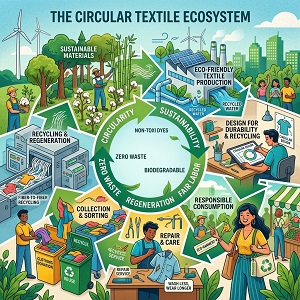
Perhaps the most radical conclusion of the report is that traditional sustainability efforts—such as switching to recycled materials or using "green" indices—are insufficient. Ogier argues that the industry is "structurally incapable" of addressing social and ecological crises because its core driver is profit through overproduction. "It’s not really about the clothes," she noted, pointing out that the industry is a prime candidate for "degrowth."
The report advocates for a paradigm shift toward degrowth economics, which prioritizes quality and longevity over planned obsolescence. By producing fewer, higher-quality items and focusing on services like repair and rental, the industry could theoretically meet human needs without the catastrophic environmental toll. While such a shift challenges the fundamental logic of modern retail, the report insists that without envisioning a different world, a "just transition" for workers and the environment will remain out of reach.