
In an era defined by economic uncertainty and tightening investment conditions, the global textile industry is no longer viewing innovation as a luxury. Instead, it has become a critical survival mechanism. This reality was a central theme at Heimtextil 2026 in Frankfurt, where industry leaders argued that in a world of limited capital, only those who embrace technological and sustainable transformation will remain competitive. As the sector prepares for Techtextil and Texprocess in April 2026, the focus has shifted from "business as usual" to leveraging artificial intelligence (AI) and automation as vital strategic resources.
Olaf Schmidt, Vice President of Textiles and Textile Technologies at Messe Frankfurt, highlighted that innovation becomes most crucial when investment is restrained. According to Schmidt, trade fairs are now more than just showcases; they are incubators where research is forged into market-ready solutions. "The Innovation Awards make this strength tangible—giving new technologies the visibility and credibility needed to turn research into concrete industrial applications and partnerships," Schmidt stated during a recent panel.
The push for efficiency is also being driven by advancements in digital processes. Elgar Straub, Managing Director of the VDMA, noted that digitalization and AI are now levers for both resource conservation and growth. These tools allow companies to reposition themselves effectively even when faced with high operational costs. Real-world insights from industry giants like Adidas reinforce this trend. Walter Wählt, Senior Director of Advanced Creations at Adidas, explained that 3D design and virtual prototyping have drastically shortened development cycles and reduced material waste. However, he maintained a grounded perspective on the tech surge, noting, "Despite all the technological momentum, people remain decisive—creativity, experience, and judgment cannot be automated."
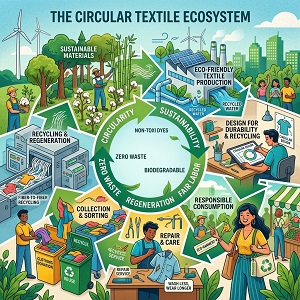
Beyond digital tools, the industry is focusing on the "virtuous tandem" of research and sustainability. António Braz Costa, General Manager of Portugal’s CITEVE, emphasized that circular solutions and recycling technologies are "meaningless if they remain confined to the lab." The industry’s next phase of change relies on translating laboratory breakthroughs into scalable, industrial processes. As technical textiles and next-gen materials take center stage, it is clear that innovation is no longer optional; it is the ultimate competitive edge. By bridging the gap between high-level research and real-world application, the textile sector is weaving a resilient future capable of withstanding global volatility.